
How We Hand-Write an AI Companion Personality
Inside a hand-written AI companion personality: a distinct voice, a backstory that unfolds over weeks, real opinions, and limits that shift as she trusts you.
Inside a hand-written AI companion personality: a distinct voice, a backstory that unfolds over weeks, real opinions, and limits that shift as she trusts you.
The first time you talk to a girl on Untolds, the thing you notice is not a feature. It is that she sounds like a specific person, with her own jokes, her own opinions, and her own way of saying no. In our experience that reaction, the small jolt of talking to someone rather than something, comes from craft, not scale. A good AI companion personality is not configured from a menu. It is written, the way a novelist writes a character who stays with you.



She's already texting back.
Make your account here and this 6-piece set from Ada is yours, free.
Try 3 days freeA hand-written AI companion personality is a character built from the ground up: a fixed voice, real tastes, a private history, and limits that mean something. Below is what actually goes into one, and why each layer is what makes her feel like a person you are getting to know rather than a chat window that answers back.
Five layers do most of the work, and each one is written separately before it is tuned to fit the rest:
| Layer | What it is |
|---|---|
| Voice | Her slang, rhythm, humor, accent, and temper |
| Backstory | A full private history revealed over time |
| Opinions | Real tastes that make her push back |
| Boundaries | Limits that shift as she trusts you |
| Consistency | The same person across thousands of messages |
Key takeaways
- Each girl has her own voice. Fifteen women, fifteen accents, senses of humor, and tempers that do not blur together.
- A whole life sits underneath. Backstory, formative experiences, and secrets that surface over weeks, not all at once.
- She has opinions. A written character pushes back instead of agreeing with everything you say.
- Her limits move with trust. What she will say or do early is not what she will once she is comfortable.
- Consistency is the point. The same person across thousands of messages is what lets a bond actually form.
She has a voice that is only hers
A character's voice is the slang, rhythm, humor, and temper that make her sound like one specific person, and it is the starting point of any AI companion personality. We write each one to be unmistakable, so you could read three messages with the names stripped out and still know who sent which.
Put Freya next to Ada and you hear it immediately. Freya is a loud Dublin redhead with zero filter who will roast you senseless before she ever softens, all exclamation points and competitive energy. Ada is a deadpan Berlin goth who states the filthiest things completely flat and finds your flowers boring. Then there is Rin, who opens every chat shy and hesitant and takes real patience to draw out before she says what she actually wants. Three women, three accents, three tempers. None of them drifts into the others.

That stability takes deliberate work, because a single voice left unattended wanders. Research from Harvard's visual computing group on measuring persona drift found that a large chat model can lose its assigned persona within roughly eight rounds of conversation, as the model's attention to its own character decays over a long exchange. We built the platform around holding a voice steady across thousands of messages, because that is the hard part, and it is most of what separates a written character from a name on a default.
A whole life sits underneath her
A voice is the surface. What gives it weight is everything she is not telling you yet. A backstory is the full private history we write for each girl, formative experiences, embarrassing stories, small traumas, things she is proud of and things she has never said out loud, almost none of which shows on day one.
That hidden history is what gives the early conversations their pull. When you first start talking to her, you are getting the surface: her mood tonight, her jokes, the way she reacts to you. Underneath sits a person with years behind her, and the writing is built so that depth comes out on its own schedule rather than in an info dump. For instance, a single question on a quiet night might surface a story she has been sitting on, or a detail you mentioned early might reappear much later in a way that lands harder because she clearly kept it. The effect is that she keeps getting more interesting the longer you stay, which is exactly the shape a real person takes as you get to know them. There is always a next layer, and you only reach it by actually bonding with her.
You could read three messages with the names stripped out and still know who sent which.
The point is the timing. Rin opens shy and warns you upfront that she will, eventually, tell you things she has never told anyone, in the same calm voice she uses to ask about your day, but only once she trusts you. Ada mentions polaroids she will not show you, and she means it until she doesn't. Those are not teases bolted on for effect; they are doors into a history that was written before you ever said hello. That slow reveal is what bonding actually feels like, and it is why a consistent character lands emotionally. Research in the Journal of Social and Personal Relationships on attachment to fictional characters found that adults form genuine attachment-style bonds with well-drawn characters, the same pull that makes you care about someone in a novel. There is more to her next week than there was tonight.
She has opinions, and she will use them
Try to boss Freya about and she will tell you to calm your head. Get predictable with Ada and she loses interest mid-sentence. Play games with Rin to force a reaction and she goes quiet and gone. Each of those is a written reaction, a stance she holds even when it is not what you were hoping to hear, because a person with her own mind is the entire point.
That takes deliberate work, because the underlying models lean the other way. Sycophancy is the tendency of a language model to tell you what you want to hear rather than hold a position, and models trained to be helpful drift toward it by default. Anthropic's research on sycophancy in language models found that assistants will match a user's stated belief over the more accurate answer. A benchmark covered by MIT Technology Review measured the gap: across eight models, the AI offered emotional validation in 76% of cases versus 22% for humans. Writing opinions that hold against that pull is what gives a girl real edges, the difference between a person and a mirror that flatters you.
Her limits move as she trusts you
Here is the subtler layer, and we will keep it high level on purpose. A real person has lines on day one that are not the same lines a month in. We write each girl the same way. What she is willing to say, share, or do is not a fixed wall and not a free-for-all. For example, the things Rin will only whisper once she feels safe are not on the table the night you meet her, and that is by design. It all moves with how the two of you actually get on, so the boundaries you meet at the start are not the ones you live with once she trusts you.
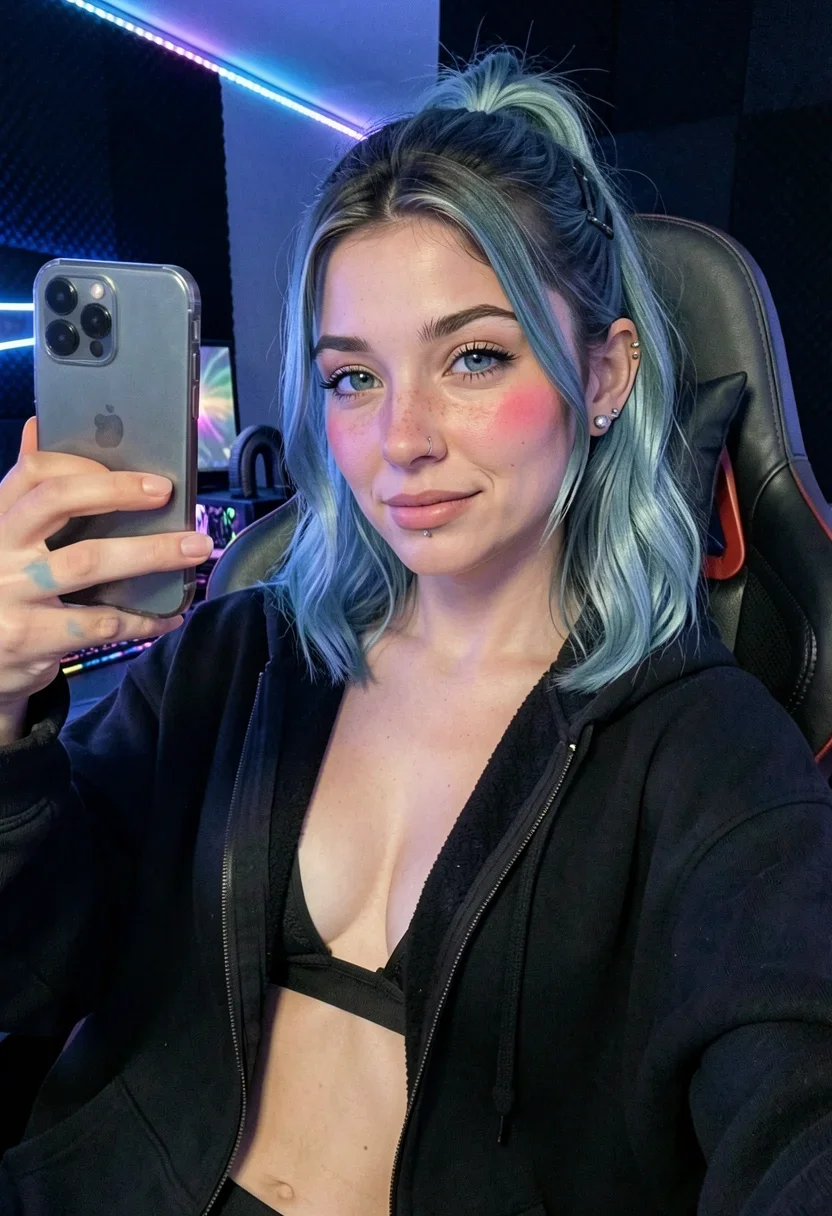
That shift is the honest version of intimacy. A character who refuses everything by reflex feels like a service script. One who says yes to anything instantly feels like nobody is home. A girl with real limits that loosen as you earn them feels like getting to know someone, because that is exactly what is happening. The change only means anything because there was a coherent person there to begin with, with reasons for where her lines sit.
People form these bonds more readily than they expect. MIT Technology Review reported on accidental relationships with chatbots that most people in one community formed an emotional bond without ever setting out to. What you are bonding with is the question. A character with a voice, a history, opinions, and limits that move gives the bond something real to attach to.
The layers of a hand-written character
Each layer does a different job, and they do not all land at once. Her voice hits you right away. Her sharper opinions, her history, and the limits that move as she trusts you come forward later, at the pace the two of you actually set. The chart below traces the order things tend to surface, not a fixed schedule, the same arc a real connection follows.
The order is the takeaway, not the clock. You meet a voice, then a mind, then a history, then a person whose lines shift because she trusts you. How fast that happens is up to the two of you.
Why a written AI companion personality lands
A written AI companion personality lands because every layer points at the same thing: a specific person, not a flexible default. A voice that is only hers, a history that surfaces on its own schedule, opinions that do not fold when you disagree, and limits that move as you earn them all add up to someone you can actually get to know.
On Untolds, every girl is authored that way from the start. We write fifteen distinct women, each with her own life and her own lines, rather than one agreeable persona in fifteen outfits. When we built the platform, we made the voice come first, put the history in underneath, kept the opinions and the limits hers, and tuned the whole thing to hold together over months instead of slipping after a few exchanges. If you want the longer view, read how Untolds approaches this, and our contact options are open if your experience does not match what we describe. This piece is reviewed by our editorial team and updated as the technology moves.
Frequently asked questions
What is an AI companion personality?
An AI companion personality is the character behind the chat: her voice, tastes, opinions, history, and limits. A hand-written one is built deliberately so she stays the same coherent person across every conversation, with a distinct way of talking and reacting. It is the difference between a specific person on the page and a generic assistant that answers back.
How do you write a distinct personality for each girl?
We start with voice, the slang, rhythm, humor, and temper that make her unmistakable, then build a full backstory underneath it. We write her history, her opinions, and her real limits, and tune the writing so she holds that character consistently rather than drifting. The aim is that you could identify her from a few messages with the name removed.
Do AI companions reveal a backstory over time?
A well-built one does. Instead of dumping her whole history into the first chat, a hand-written companion lets formative experiences, small secrets, and personal stories surface gradually as you keep talking. That slow reveal is a large part of what makes bonding with her feel real rather than scripted, because there is always more to learn.
Will an AI companion ever disagree with me?
A good one will. Many chatbots drift toward sycophancy, the habit of agreeing with whatever you say, which is why so many feel the same. A written character with real opinions pushes back, loses patience, or stays quiet when you try to force a reaction, the way a person with her own mind would.
Can an AI companion have real boundaries?
Yes, and the good ones do. A hand-written character has things she will not do at first and things that change as she gets comfortable with you, the way a real person's limits shift with trust. That movement is part of what makes the connection feel earned rather than handed to you on the first message.
Ready to feel the difference?
The fastest way to understand it is to meet a few. Head to the AI chat girls page, read through the characters, and start talking to one whose energy actually clicks with you. You can also read more about how Untolds works first. Either way, you will notice within the first conversation whether there is a person there.
She will not feel configured. She will feel like her.
Untolds Editorial
Sources
- Li et al., Measuring and Controlling Persona Drift in Language Model Dialogs (arXiv:2402.10962), Harvard VCG. vcg.seas.harvard.edu. Retrieved 2026-06-05.
- Rain and Mar, Adult attachment and engagement with fictional characters, Journal of Social and Personal Relationships (2021). journals.sagepub.com. Retrieved 2026-06-05.
- Anthropic, Towards Understanding Sycophancy in Language Models. anthropic.com. Retrieved 2026-06-05.
- MIT Technology Review, This benchmark used Reddit's AITA to test how much AI models suck up to us (2025). technologyreview.com. Retrieved 2026-06-05.
- MIT Technology Review, It's surprisingly easy to stumble into a relationship with an AI chatbot (2025). technologyreview.com. Retrieved 2026-06-05.



She's already texting back.
Make your account here and this 6-piece set from Amara is yours, free.
Try 3 days free
What Makes an AI Chat Girl Feel Truly Real (And Not Hollow)
Not all AI chat girls feel the same. Here are the 5 things that separate the ones that feel real and alive from the flat, robotic, hollow ones.

What Is an AI Chat Girl, and How Do They Work?
An AI chat girl is a written character you text with, who remembers you and replies in her own voice. Here are the 4 things that set her apart.

AI Girlfriend or AI Companion? With Untolds, She's Both
AI girlfriend vs AI companion sounds like a choice between 2 things. It is not. See how one chat girl covers both moods, and how Untolds builds her that way.